Hyperthyroidism, Graves’ Disease
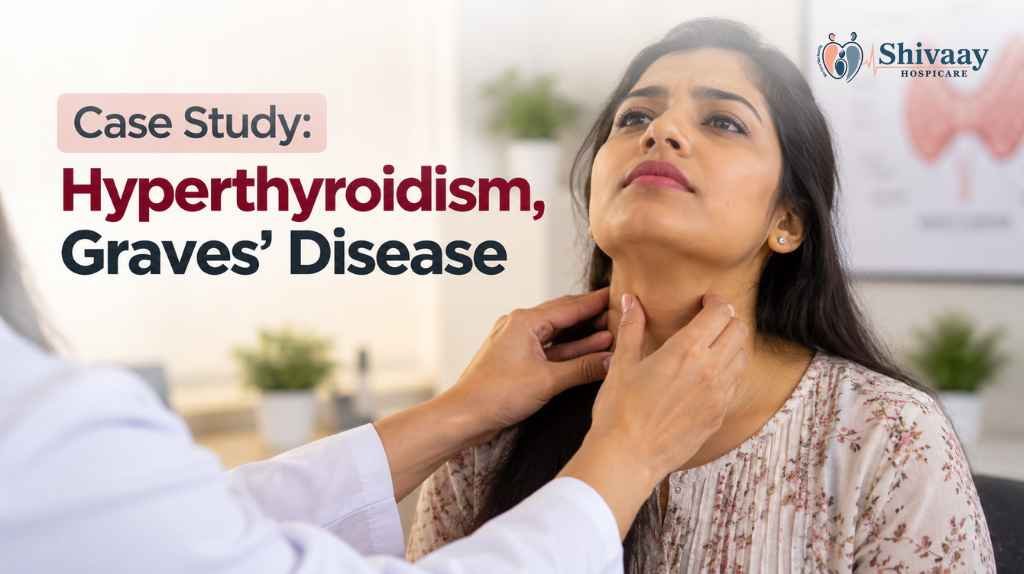
A 34-year-old female school teacher presented with palpitations, unintentional weight loss, excessive sweating and anxiety that had developed over three months. Despite having an increased appetite, she had lost approximately 6 kg during this period. She also reported heat intolerance, tremulousness, irritability, disturbed sleep and increased bowel frequency. Clinical examination revealed tachycardia, a fine hand tremor and a diffusely enlarged, non-tender thyroid gland. Thyroid function tests demonstrated overt hyperthyroidism, while positive TSH receptor antibodies and increased thyroid vascularity supported a diagnosis of Graves’ disease.
Patient Profile
- Age: 34 years
- Sex: Female
- Occupation: School teacher
- Chief complaints: Palpitations, weight loss, increased sweating and anxiety for 3 months
History of Present Illness
The patient reported a 6-kg unintentional weight loss over three months despite an increased appetite. She also complained of heat intolerance, excessive sweating, tremulousness, irritability and difficulty sleeping.
She had noticed increased frequency of bowel movements and occasional palpitations.
There was no history of fever, neck pain or recent exposure to iodinated contrast.
She had no previous history of thyroid disease.
Clinical Examination
The patient was clinically stable apart from tachycardia.
- Pulse: 112/min, regular
- Blood pressure: 136/72 mmHg
- Temperature: 37.1°C
- Hand examination: Fine tremor present
- Skin: Warm and moist
- Thyroid: Diffusely enlarged and non-tender
- Thyroid nodules: None detected
- Eyes: Mild bilateral lid retraction
- Pretibial myxoedema: Absent
- Clinical heart failure: No evidence
Diagnostic Assessment
Laboratory investigations were performed to establish the presence and cause of thyrotoxicosis and to assess suitability for treatment.
Investigation | Result |
TSH | <0.01 mIU/L |
Free T4 | 3.1 ng/dL |
Free T3 | 8.2 pg/mL |
TSH receptor antibody (TRAb) | Positive |
Anti-TPO antibody | Positive |
CBC | Normal |
Liver function tests | Normal |
Serum calcium | Normal |
ECG | Sinus tachycardia |
Thyroid Ultrasound
Ultrasound of the thyroid demonstrated diffuse enlargement with increased vascularity and no dominant thyroid nodule.
Diagnosis
The findings were consistent with:
Graves’ disease causing overt hyperthyroidism.
The diagnosis was supported by the combination of markedly suppressed TSH, elevated free T4 and free T3, diffuse goitre, positive TRAb and increased thyroid vascularity.
Management
1. Symptomatic Treatment
A beta-blocker such as propranolol may be used to provide symptomatic relief from palpitations, tremor and anxiety when there are no contraindications.
Beta-blockers help control adrenergic symptoms but do not treat the underlying thyroid hormone overproduction.
2. Antithyroid Therapy
A thionamide such as methimazole or carbimazole is commonly used in the treatment of Graves’ disease. The dose is adjusted according to thyroid hormone levels and the patient’s clinical response.
Baseline complete blood count and liver function assessment may be appropriate before initiating treatment.
The patient should be advised to seek prompt medical attention if she develops fever or severe sore throat, as agranulocytosis is a rare but potentially serious adverse effect of antithyroid medication.
3. Definitive Treatment Options
Depending on individual clinical factors and patient preference, longer-term treatment options may include:
- Radioactive iodine therapy
- Thyroidectomy
- Continued antithyroid drug therapy in selected patients
The choice of treatment should consider factors such as the severity of disease, thyroid size, presence of eye disease, treatment preferences and other relevant clinical considerations.
Follow-Up
Regular monitoring was planned to assess treatment response and ensure appropriate adjustment of therapy.
- Free T4 and/or free T3 should be monitored after treatment initiation and used to guide antithyroid drug dose adjustments.
- TSH may remain suppressed for some time after treatment begins and should not be used as the sole parameter for early dose adjustment.
- The patient should be monitored for adverse effects associated with antithyroid medication.
- Clinical assessment should include monitoring for the development or progression of Graves’ orbitopathy.
- Heart rate and symptoms such as palpitations, tremor and heat intolerance should also be reassessed.
Expected Outcome
With appropriate treatment, thyroid hormone levels are expected to gradually return towards the normal range. As biochemical control is achieved, symptoms such as palpitations, tremor, excessive sweating, anxiety and weight loss should improve.
Long-term follow-up is important because Graves’ disease can relapse after treatment, and some patients may require definitive therapy.
Key Learning Points
- Suppressed TSH with elevated free T4 and/or free T3 indicates overt hyperthyroidism.
- Graves’ disease is an important cause of hyperthyroidism, particularly in younger adults.
- Positive TSH receptor antibodies support the diagnosis of Graves’ disease.
- Beta-blockers provide rapid relief of adrenergic symptoms but do not correct the underlying thyroid overactivity.
- Antithyroid medication, radioactive iodine and surgery are potential treatment approaches, and the choice should be individualised.
- Patients receiving antithyroid medication should be aware of important warning symptoms such as fever or severe sore throat.
- Assessment for Graves’ orbitopathy is an important part of ongoing management.
Conclusion
This case demonstrates Graves’ disease presenting as overt hyperthyroidism in a young adult. The combination of characteristic symptoms, clinical findings, suppressed TSH, elevated thyroid hormones, positive TRAb and increased thyroid vascularity supported the diagnosis.
Management involves controlling symptoms, reducing thyroid hormone production and selecting an appropriate long-term treatment strategy. Regular monitoring is essential to assess thyroid function, medication safety and the potential development of Graves’ orbitopathy.
Contact Us to learn more about thyroid evaluation and management at Shivaay Hospicare.
Medical Note: This case study is intended for educational purposes only. Diagnosis and treatment should be based on an individual clinical assessment by a qualified healthcare professional.